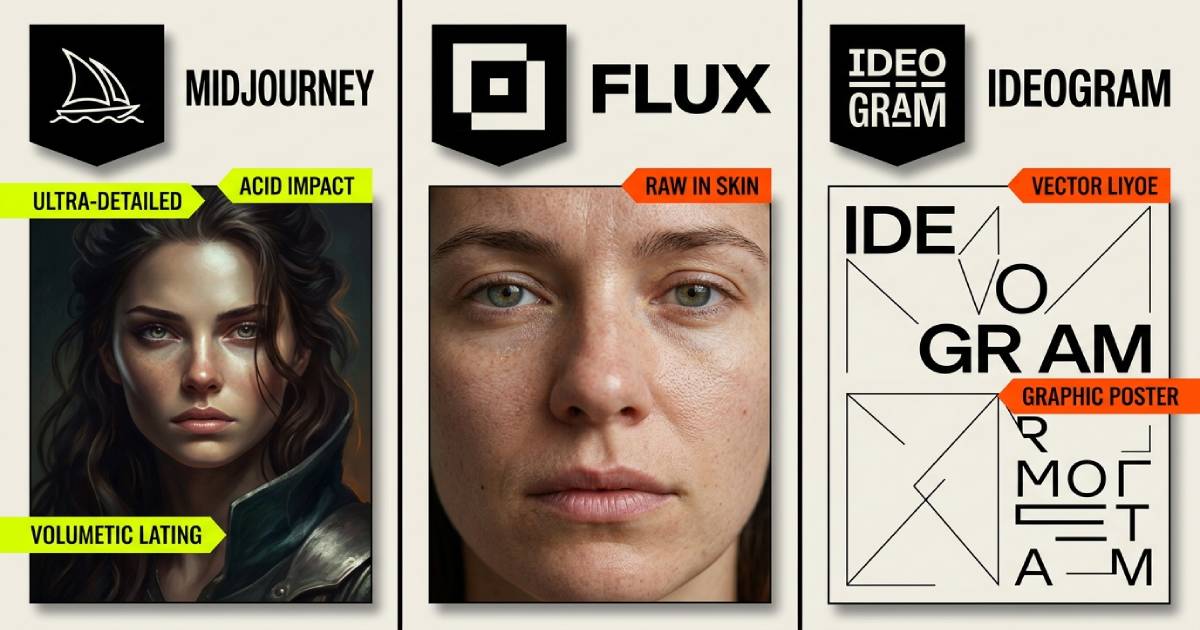
For nearly three years, generative image benchmarks were reduced to a superficial aesthetic race: whoever generated the most cinematic portrait with glossy skin and volumetric lighting won the crown. In production environments, that metric is completely dead. Creative directors, indie developers, and digital product builders don't just care about vibe; they need pixel-level typographic accuracy, spatial prompt adherence, and zero anatomical drift across campaign runs.
Today, three distinct visual engines dominate serious workflows: Midjourney, the open-weight titan FLUX.1 by Black Forest Labs, and Ideogram, the typographic specialist. We pitted all three systems against identical, uncompressed stress prompts across four real-world production challenges. Here is the unvarnished breakdown.
The Contenders & Their Architectural Trade-offs
Before looking at output renders, understanding the foundational trade-offs of each engine explains why they fail where they fail:
- Midjourney (v7 Engine): Built on proprietary closed-source diffusion architectures with integrated stylistic upscalers. It prioritizes art direction, cinematic contrast, and cohesive lighting above strict literal prompt translation. Available exclusively via web studio and Discord.
- FLUX.1 (Schnell, Dev, Pro): A 12-billion parameter flow-matching transformer engineered by the original Stable Diffusion core team. It treats text understanding via a dedicated T5 encoder, offering an unprecedented balance between prompt adherence, realistic skin micro-textures, and permissive open-weight deployment via local ComfyUI setups or low-latency cloud APIs.
- Ideogram: An architecture tuned specifically to solve the historical curse of illegible on-image text and typography layout, packaging built-in prompt expanding tools and clean graphic design presets.
Test 1: In-Canvas Typography & Commercial Poster Layout
The Prompt: "A vintage brutalist travel poster for a high-speed train route. Bold distressed typography at the top reading 'BERLIN EXPRESS 2026'. At the bottom, clean subtitle text reading 'DEPARTURE PLATFORM 04'. Minimal geometric vector style, cream background, heavy black ink lines, burnt orange accents."
Rendering typography inside a diffusion model requires the neural net to understand letterforms as spatial vectors rather than generic visual textures. Here is how each engine performed:
- Ideogram: Flawless execution. All characters in "BERLIN EXPRESS 2026" rendered without spelling hallucinations, character merging, or kerning issues. The secondary subtitle maintained perfect letter height and horizontal alignment without blurring into background shapes.
- FLUX.1: 95% accuracy. Both strings were spelled correctly on the first generation pass. The primary headline was crisp, although the smaller subtitle text showed slight character weight variations on two letters. For merchandise and t-shirt vector assets, FLUX.1 remains fully production-grade.
- Midjourney v7: Noticeable improvement over earlier generations, but still trailing. While "BERLIN" and "2026" rendered cleanly, "EXPRESS" frequently drifted into pseudo-latin glyphs on complex compositions. Fine-print secondary text required multiple inpainting rerolls to get legible results.
Winner: Ideogram for typography-first branding; FLUX.1 a close second for hybrid vector compositions.
Test 2: Complex Spatial Logic & Multi-Subject Adherence
The Prompt: "A photo taken from a high angle: a wooden desk with exactly three objects. On the far left, a matte green ceramic coffee mug with steam rising. In the dead center, a closed silver laptop with a circular orange sticker. To the far right, a small brown leather notebook with an antique brass pen resting across its cover. Natural window lighting from the right."
Most models fail spatial logic by hallucinating additional items, swapping colors between adjacent objects, or completely ignoring lighting orientation constraints.
- FLUX.1: Nailed all positional parameters. The T5 text encoder clearly separated "green mug left" from "silver laptop center" and "orange sticker". Object counts were respected on 4 out of 4 test generations, and lighting shadows realistically fell toward the left side as specified.
- Midjourney v7: Delivered the most aesthetically striking composition with dramatic film grain and atmospheric depth, but failed prompt adherence. It added scattered paperclips, glasses, and an extra coffee cup to "beautify" the frame, ignoring the explicit constraint of "exactly three objects."
- Ideogram: Placed the objects in the correct order, though lighting physics across the desk felt flat and slightly artificial compared to the depth generated by FLUX.1.
Winner: FLUX.1. If your workflow depends on programmatic prompts with strict asset placement, FLUX is noticeably more reliable than Midjourney.
Test 3: Human Anatomy, Micro-Expressions & Skin Realism
The Prompt: "Raw 35mm street photography portrait of a 60-year-old ceramicist in his workshop. Natural wrinkles around eyes, hands covered in dried grey clay, fingernails visible holding a small unglazed terracotta cup. Daylight through dirty warehouse windows, shallow depth of field, authentic film texture, zero airbrushing."
Here, the fight is between organic human texture and over-smoothed "AI plastic" aesthetics.
- Midjourney v7: Midjourney's default aesthetic remains unmatched when it comes to mood. Skin wrinkles look natural, the cinematic lighting feels deliberate, and emotional eye contact is captivating. Hand anatomy has improved dramatically—fingers rarely fuse, though fingernail beds occasionally show minor geometry seams.
- FLUX.1: The most photorealistic skin rendering currently available. Unlike Midjourney's slight cinematic bias, FLUX renders unglamorized pores, peach fuzz, authentic scars, and realistic dried clay cracks across knuckles without looking artificial. Hand pose geometry was flawless across test seeds.
- Ideogram: Clean, but still carries a faint digital illustration sheen. Human portraits generated by Ideogram feel closer to high-end digital concept art than genuine 35mm film captures.
Winner: Tie between FLUX.1 (for documentary realism) and Midjourney v7 (for artistic and editorial campaigns).
Test 4: Workflow Control, Speed & Economic Viability
A tool can produce magnificent images, but if it locks you into a Discord bot or charges prohibitive subscription fees per generation, scaling a business on it becomes impossible.
| Feature & Metric | Midjourney v7 | FLUX.1 (Dev/Pro) | Ideogram |
|---|---|---|---|
| License Model | Proprietary Closed SaaS | Open Weights (Apache 2 / Dev) | Proprietary SaaS |
| Local Execution | No (Cloud only) | Yes (ComfyUI, WebUI, Forge) | No (Cloud only) |
| Typography Grade | B+ (Basic slogans) | A- (Very reliable) | A+ (Flawless design layout) |
| Inpainting / Canvas | Web Editor with Zoom/Pan | Granular node masking | Integrated Canvas UI |
| Entry Pricing | $10/mo (No free tier) | Free (Local) / Pay-per-megabyte | Free tier / $7/mo |
The Practical Verdict: Which Tool Should You Pick?
There is no longer a single "best" AI image model. The market has matured into specialized operational roles:
- Choose FLUX.1 if: You are building production apps, need absolute control over prompt parameters, require offline local hosting for data privacy, or want hyper-realistic human skin without proprietary lock-in. It is currently the most versatile visual foundation in the world.
- Choose Ideogram if: Your primary business is print-on-demand merchandise, apparel designs, logo ideation, marketing banners, or poster typography where misspelled words directly ruin commercial viability.
- Choose Midjourney if: You are an art director, concept illustrator, or marketer prioritizing unmatched editorial lighting, cinematic taste, and quick visual mood boards without tweaking complex technical dials.
For high-output creators, the modern sweet spot is often a hybrid stack: ideating concepts inside Midjourney or Ideogram, and taking production-scale batches through local or API-driven FLUX.1 workflows.