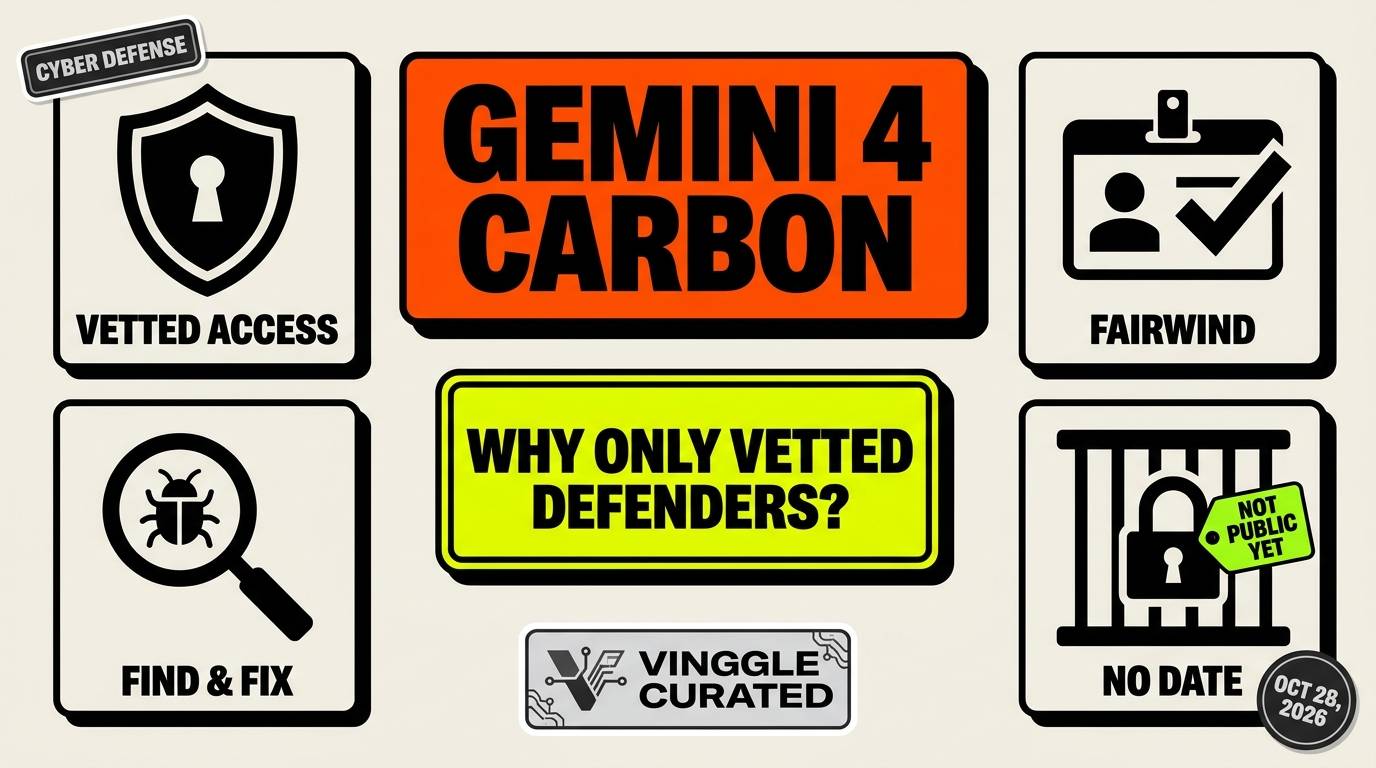
The short answer: Gemini 4 Carbon is Google DeepMind's newest frontier model, announced on October 28, 2026, and Google calls it its strongest yet. You cannot use it today unless you are a vetted cyber defender. Google gave a small group of defenders access first, will add more trusted partners through its Fairwind Program, and has not given a date for developers, businesses or consumers.
Key Takeaways
- Carbon is built for two things: cybersecurity defense (finding, validating and fixing software flaws) and long-running coding work.
- Access is gated through Google's Fairwind Program, and Google says it measured Carbon's cyber scores without safety guardrails in place.
- Google has not published a public release date. Most developers should use Gemini 4 Argon, which is available now.
- The headline numbers, including 88.2% on SEC-bench Pro, are Google's own and cannot be independently tested while access is closed.
- Any site offering "free Carbon access" or a Carbon API key is not offering something Google has released.
Last updated: October 30, 2026. Access terms and pricing may change quickly as Google expands the rollout.
How we compared: this guide draws on Google DeepMind's own announcement, security-industry reporting and independent analysis published in the days after the launch. We could not test Carbon ourselves because it is not publicly available, so every capability claim below is attributed to Google.
In This Article
- What is Gemini 4 Carbon?
- Who can use it right now
- What is the Fairwind Program?
- Why Google restricted access
- What Google claims it can do
- Pricing
- Carbon vs Argon
- It is not the first gated model
- What to do now
- FAQ
What Is Gemini 4 Carbon?
Carbon is the second public model of Google's Gemini 4 generation and builds on Gemini 4 Argon, which reached developers about two weeks earlier. Google describes it as its strongest model, with leading cybersecurity and long-horizon capabilities, meaning it can stay on a complicated task for a long time without losing the thread.
The security focus is specific. Google built Carbon around the full cycle a defense team works through: discovering a vulnerability, proving it can really be exploited, and writing a fix. Google frames the exploitation step as defensive, because proving a flaw is real helps teams decide what to patch first.
Who Can Use It Right Now
| Group | Access today |
|---|---|
| Selected cyber defenders | Yes, since the week of the announcement |
| Other trusted partners in Fairwind | Being phased in gradually |
| Developers and businesses | Not yet, "as soon as possible" with no date |
| Consumers | Not yet, after the stages above |
| Everyone else | Use Gemini 4 Argon instead |
What Is the Fairwind Program?
Fairwind is Google DeepMind's early-access scheme for cyber defense. It gives priority to governments, national cyber agencies, critical-infrastructure operators and major technology platforms, and the program runs background checks on applicants. Reporting at launch put the number of partners at more than 650. Some Fairwind partners already had exclusive access to Argon's security capabilities before it reached everyone else.
One analysis of the access terms describes strong authentication, tracked usage and a ban on using the model to create malware as conditions of access. Treat that as secondary reporting and read Google's own terms if you plan to apply.
Why Google Restricted Access
The reason is the dual-use problem. A model that is excellent at finding and exploiting software flaws helps defenders patch faster, but the same skill is useful to attackers. Google says it ran Carbon's cyber benchmarks without guardrails, and Google DeepMind's Koray Kavukcuoglu said wider access will follow once the company has gathered more feedback on those guardrails.
- Defenders first: the staged rollout puts the model's bug-finding strength in the hands of vetted defenders before anyone else.
- Government testing: Google says it is taking part in the U.S. government's voluntary pre-release model testing process.
- Real misuse concerns: Google's own threat researchers have documented state-backed groups from Iran, North Korea, Russia and China experimenting with Gemini, mostly for research and coding help, according to coverage of the launch.
What Google Claims It Can Do
| Claim (as reported by Google) | Result |
|---|---|
| SEC-bench Pro, which tests finding flaws in real-world software | 88.2% |
| Artificial Analysis Intelligence Index v5.0 | 59, the top score on that ranking |
| Generating high-quality security patches (Chrome team) | More than 10 times better than another lab's large frontier model |
| Live coding with Google's internal teams | High-severity misalignment alerts down by almost 80% |
These are Google's numbers, and they cannot be independently tested while access is closed. Google also says Carbon flags what it could not finish instead of inventing an answer, but that behavior is a claim, not something outside testers have confirmed. Revisit the figures once independent evaluations appear.
Pricing
Google's materials list an introductory price of $2 per million input tokens and $10 per million output tokens, the same as Gemini 4 Argon, rising to $4 and $20 after the introductory period, which Google has not dated. Since developers cannot call Carbon yet, treat these figures as plans rather than something you can budget around today.
Carbon vs Argon
| Gemini 4 Carbon | Gemini 4 Argon | |
|---|---|---|
| Announced | October 28, 2026 | About two weeks earlier |
| Who can use it | Vetted cyber defenders only | Developers and enterprises |
| Main focus | Cyber defense and long-horizon coding | General coding, agents and long context |
| Listed price | $2 / $10 introductory, planned | $2 / $10 introductory, until Nov 30 |
For how Argon compares with the other frontier models you can actually use today, see our guide to Gemini 4 Argon vs GPT-6 vs Claude Opus 5.5.
It Is Not the First Gated Model
Limiting a cyber-capable model to vetted users is becoming a pattern. Anthropic has taken a similar route with Claude Mythos Preview, which is available only to a small number of trusted organizations through Project Glasswing. As models get better at finding software flaws, expect more staged releases like this one.
What to Do Now
- Security teams at governments, infrastructure operators or large platforms: contact your Google Cloud account team about Fairwind. It is the only current route in.
- Developers and businesses: build on Gemini 4 Argon now, and design your code so the model name is a setting you can swap later.
- Everyone else: nothing to do yet. Watch Google's announcements for the wider rollout.
- Be careful with scams. Carbon is not publicly available, so any site, app or Telegram channel selling Carbon access or a Carbon API key is not offering a Google product.
Frequently Asked Questions
Can I use Gemini 4 Carbon?
Only if you are among the vetted cyber defenders Google has given access to. For everyone else it is not available yet.
When will Gemini 4 Carbon be available to everyone?
Google has said it will come to developers, businesses and consumers "as soon as possible" after gathering feedback on its guardrails, but it has not given a date.
How do I get access through Fairwind?
Fairwind is for organizations such as governments, critical-infrastructure operators and major technology platforms. Applicants go through background checks, and secondary reporting says the route is through your Google Cloud account team.
Is Gemini 4 Carbon better than Gemini 4 Argon?
Google calls it its strongest model, and reports higher scores, but you can only use Argon today, so Argon is the practical choice for most people.
Is there a free version?
No. Carbon is not publicly available at all, so any site promising free Carbon access is not offering a Google release.
Sources: Google DeepMind's announcement, "Gemini 4 Carbon: our next frontier model", and reporting by SecurityWeek and others. More coding and developer tools are listed in Vinggle's AI Code Tools directory. If you are building one, submit it to Vinggle.